
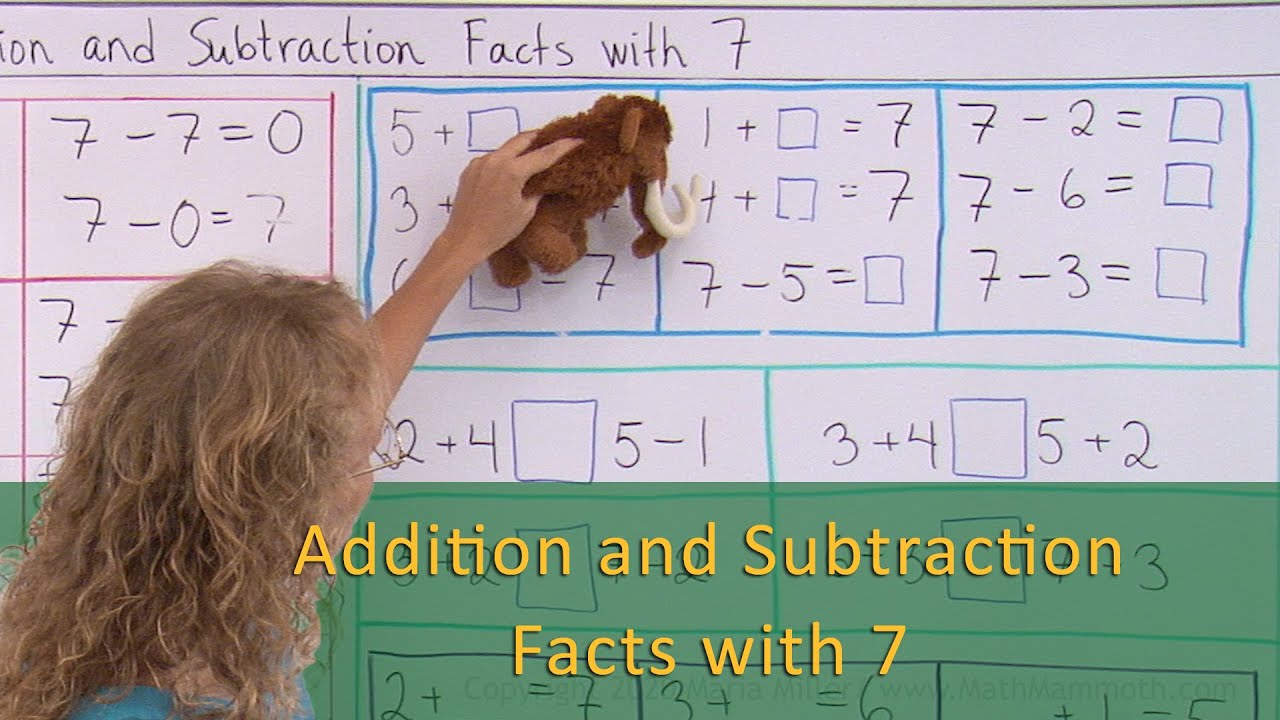
I show all the fact families with the sum of 7, organized into a table. Seeing the structure and the patterns in this manner helps develop number sense and helps children in the memorization work, also. Then we drill the facts for a bit. The lesson also includes an exercise where we compare expressions ("alligator mouths") and draw lines connecting facts from the same fact family.
Maaari Mo Ring Magustuhan
PrePrimary Maths
Year1 Maths
Year 11 Math
Year2 Maths
Year 10 Math
Year4 Maths
How to Play Chess
6th Grade Math
Algebra I | High School Math | Khan Academy
Math Videos for Kids
Trigonometry | High School Math | Khan Academy
Algebra II | High School Math | Khan Academy
Year9 Maths
Maths
Numberblocks - Learn to Count | Maths for Kids
Fresh Starts with Numberblocks! ❄️ | Learn to Count for Kids
Numberblocks Special Moments ✨
Kids Songs by CoComelon
Learn Colors with CoComelon!
Year1 English
Year3 Maths
Year 8 Math
3rd Grade Math
CoComelon
Mga Komento
8 Mga Komento
I show all the fact families with the sum of 9, organized into a table. Seeing the structure and the patterns in this manner helps develop number sense and helps children in the memorization work, also. Then we drill the facts for a bit. The lesson also includes a missing number exercise, an exercise where we compare simple addition and subtraction expressions, and word problems (with Mathy :^).
I show all the fact families with the sum of 9, organized into a table. Seeing the structure and the patterns in this manner helps develop number sense and helps children in the memorization work, also. Then we drill the facts for a bit. The lesson also includes a missing number exercise, an exercise where we compare simple addition and subtraction expressions, and word problems (with Mathy :^).
I show all the fact families with the sum of 6, organized into a table. Seeing the structure and the patterns in this manner helps develop number sense and helps children in the memorization work, also. Then we drill the facts for a bit. The lesson also includes an exercise where draw lines connecting facts from the same fact family, and a word problem.
I show all the fact families with the sum of 6, organized into a table. Seeing the structure and the patterns in this manner helps develop number sense and helps children in the memorization work, also. Then we drill the facts for a bit. The lesson also includes an exercise where draw lines connecting facts from the same fact family, and a word problem.
I show all the fact families with the sum of 8, organized into a table. Seeing the structure and the patterns in this manner helps develop number sense and helps children in the memorization work, also. Then we drill the facts for a bit. The lesson also includes an exercise of finding missing numbers (a little bit of algebra in disguise), and some word problems.
I show all the fact families with the sum of 8, organized into a table. Seeing the structure and the patterns in this manner helps develop number sense and helps children in the memorization work, also. Then we drill the facts for a bit. The lesson also includes an exercise of finding missing numbers (a little bit of algebra in disguise), and some word problems.
I show all the fact families with the sum of 7, organized into a table. Seeing the structure and the patterns in this manner helps develop number sense and helps children in the memorization work, also. Then we drill the facts for a bit. The lesson also includes an exercise where we compare expressions ("alligator mouths") and draw lines connecting facts from the same fact family.
I show all the fact families with the sum of 7, organized into a table. Seeing the structure and the patterns in this manner helps develop number sense and helps children in the memorization work, also. Then we drill the facts for a bit. The lesson also includes an exercise where we compare expressions ("alligator mouths") and draw lines connecting facts from the same fact family.