
Maaari Mo Ring Magustuhan
Kids Songs by CoComelon
Learn Colors with CoComelon!
Year1 English
CoComelon & Friends Holiday and Christmas Videos for Kids | Little Baby Bum | Go Buster and More!
CoComelon
Alphabet (ABC) Songs by CoComelon
CocoMelon | Little Baby Bum | Blippi - Nursery Rhymes & Kids TV Shows
CoComelon - Happy Holidays
Charlie and Lola Full Episodes
How to Be a Better Human
Numberblocks & Alphablocks - Learn to read and count #readingmonth
New Compilations | Chuggington
Learn English With Disney Movies
Test Your English with TV Series and Movies
CoComelon #shorts
All New Akili & Me
KS2 Drama
SS 1 Mathematics
CoComelon For Journeys
Nursery Rhymes by CoComelon
Recent videos we think you’ll love
JoJo and Gran Gran
Special Videos
Hey Duggee
Mga Komento
10 Mga Komento
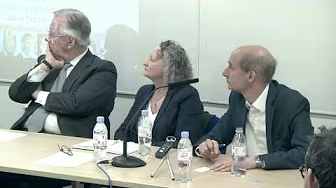
Date: Wednesday 21 January 2015 Time: 18:30-20:00 Venue: 32L.G.03 Speakers: Simon Hix, Tony Travers, Andrew Blick, Martin Loughlin Chair: Kate Jenkins The fallout from the Scottish referendum has been profound for the whole of the UK. The Smith Commission has proposed radical further devolution for Scottish taxes and powers, while there are demands to deliver ‘English votes for English laws’. William Hague, on behalf of the government, has put forward four options for possible reform. Any change to the British ‘constitution’ will be difficult because there is no settled starting-point. This panel will examine options for the future of the British constitution in 2015 and beyond
Date: Tuesday 27 January 2015 Time: 18:30 - 20:00 Venue: NAB.LG.01 Wolfson Theatre Speakers: Robert Worcester, David Butler, Vernon Bogdanor Chair: Kate Jenkins The 2015 general election will be momentous. It is virtually impossible to predict the outcome of such a tightly-run race. Labour and the Conservatives have seen their National vote share decline from 97 per cent to 65 per cent between 1955 and 2010. UKIP, the SNP, the Greens and other incumbent parties are possibly on the rise. This special event brings together a number of Britain’s leading election and constitutional experts to consider what past elections can tell us about the 2015 contest. Which were the great general elections, and who were the great party leaders?
Date: Thursday 12 February 2015 Time: 18:30 - 20:00 Venue: CLM 2.02 Speakers: Chris Brown, Michael Cox, Toby Dodge, Margot Light Chair: Professor Tony Travers The UK has been involved in a number of international conflicts and peace-keeping efforts in recent years. But pressure on the defence and Foreign Office budgets is likely to change the shape of the armed forces and to affect Britain’s position in the world. Negotiations about a possible coalition government might have implications for the UK’s nuclear deterrent. A Strategic Defence Review is expected in 2015 and this document will outline the longer-term options facing the country. This panel will look at the immense problems facing the next government as it seeks to adjust the scale and shape of defence and foreign policy #LSEDefence
Date: Wednesday 18 February Time: 18:30 - 20:00 Venue: CLM.4.02 Speakers: Nick Barr, Tim Leunig, Nona Buckley-Irvine Chair: Paul Kelly The political consequences of the Coalition’s student fees policy have affected the government in a number of ways. Potential change to the funding of universities and students remains highly contentious and subject to reform. Fee levels will be an issue in the 2015 election. Differences in policy between England and Scotland remain contentious. In the longer-term, pressure on ‘unprotected’ public expenditure is likely to reduce HE funding still further, creating greater need for a wider range of university income. The way in which students fund their education, and over what period, has profound impacts. This panel will look at the options facing the parties and those in higher education. #LSEEduFunding
Date: Thursday 19th February Time: 18:30 - 20:00 Venue: CLM.3.02 Speakers: Nancy Holman, Christine Whitehead, Tony Travers, Stephen Glaister Chair: Tim Donovan As London moves towards becoming a city of 10 million people, it faces immense challenges related to planning, housing, governance and transport. Accommodating this rapid rise in population will require London’s leaders to rethink how and where the city should provide homes for its residents, how people travel into and move around the capital, and how best to plan for this growth to keep London liveable. These questions are already at the forefront of the policy debate, and the 2016 Mayoral candidates will certainly be expected to forward innovative ideas for London’s future. This panel will discuss the viability of some current proposals for tackling these challenges, including changes to S106 processes, strategies for meeting housing targets, outward expansion into the green belt and the need for better cooperation with adjoin
The NHS, education, children’s services and social security are among the most politically-salient issues affecting the outcome of the 2015 election. Polling shows the public strongly supports additional funding for health, though it is less enthusiastic about aspects of welfare. Children’s services are now very high-profile and require continuing political and official action to deliver effective care. In parallel, measures of inequality suggest Britain has become a less equal society and that there is political pressure to do something to reduce both income and wealth differentials. Despite protection for the NHS and pensions, budgets for most Welfare State services are under immense pressure. This panel will consider the limited choices for the major parties as the approach the election.
Speakers: Damian Chalmers, Sara Hagemann, Simon Hix, Sara Hobolt, Michiel van Hulten Chair: Maurice Fraser The 2015 election could lead to an ‘In-Out’ referendum by 2017. The UK might, therefore leave the EU before the following election, with profound effects on the country and its trading partners. There would also be knock-on consequences for the future of Scotland within the UK. UKIP’s performance in the general election will also tell us something about the strength of sentiment about immigration policy in the UK. Whether or not there is a referendum, Britain’s troubled relationship with Europe looks likely to remain difficult for some years to come. This panel will look at the many and varied challenges facing Britain and its relationship with Europe between 2015 and 2020.
Speakers: Charles Goodhart, Nancy Holman, Anne Power, Christine Whitehead Chair: Kate Allen, Financial Times Housing presents a range of challenges for whichever party wins the next election. Everyone agrees there is a shortage of homes (to rent or to buy) as well as an affordability crisis in many parts of the country, and yet housing completions are at historically low levels. Experts have listed a number of reasons for the lack of new investment including the planning process, the lack of available land, a shortage of finance, restrictions on building on the Green Belt, the influence of overseas buyers, and indeed cutbacks in government grant. Additionally, increasing regulation is making it harder for households who would traditionally have been able to become owner-occupiers to do so. Increasing numbers of families—especially in London—are paying high rents for poor quality and insecure accommodation. Consequently, policies to increase investment and standards in the private rente
On 24 March 2015 David Lammy MP gave a talk as part of our British Government public lecture series. He discusses the unique opportunities and challenges that exist in London with a focus on how to ensure that all Londoners benefit from the capital's energy and dynamism.
Released on 24 April Speakers: John Van Reenen, Alan Manning, Jonathan Wadsworth Chair: Tony Travers The Conservatives and Labour have marked out apparently different positions for themselves in relation to the economy and deficit reduction. The Conservatives want to eradicate the deficit and then run a budget surplus, while Labour want to deliver a slower reduction to the deficit, but with less pressure on public expenditure. The longer-term strength of the UK economy is still unknown, particularly in the light of continuing uncertainty affecting the Eurozone, financial institutions and oil prices. The options facing the new government are limited by the continuing weakness of the public finances. We examine the future of the UK economy and possible policy change.