
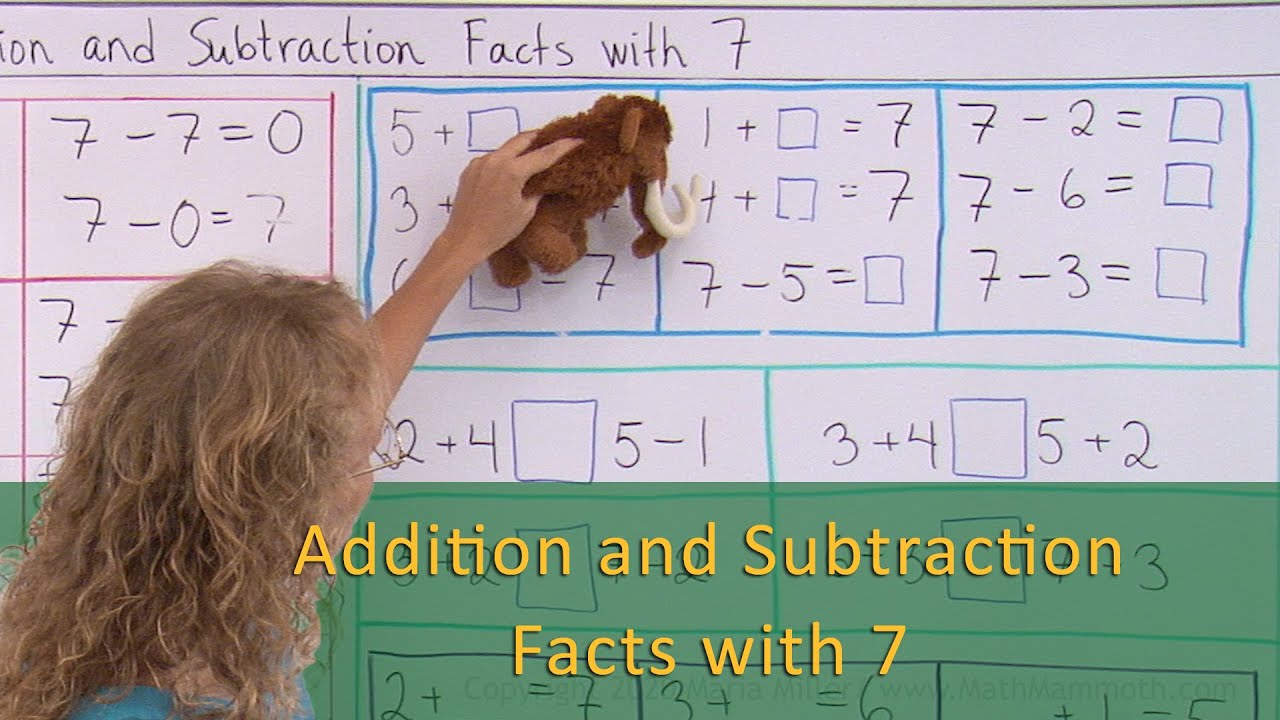
I show all the fact families with the sum of 7, organized into a table. Seeing the structure and the patterns in this manner helps develop number sense and helps children in the memorization work, also. Then we drill the facts for a bit. The lesson also includes an exercise where we compare expressions ("alligator mouths") and draw lines connecting facts from the same fact family.
آپ کو یہ بھی پسند آ سکتا ہے
ChuChu & Friends in Storytime Adventures - ChuChu TV
Popular Compilations by CoComelon
ABCs Learn the Alphabet
Halloween Songs For Kids - CoComelon
Kids Songs by CoComelon
CoComelon
Alphabet (ABC) Songs by CoComelon
CocoMelon | Little Baby Bum | Blippi - Nursery Rhymes & Kids TV Shows
PrePrimary Maths
Year1 Maths
Year 11 Math
Year2 Maths
3rd Grade Math
3rd Grade Fractions
6th Grade Math
Numberblocks - Number Adventures | Learn to Count | Maths for Kids
Math for Kids
Geometric Progression Class 3 - Representation of 3 Terms in a G.P. \Prof. Gis/
Introduction to Systems of Linear Equations (Tagalog/Filipino Math)
Fun Math Videos For 4th Graders
Numberblocks - Learn to Count | Maths for Kids
Numberblocks - Homeschooling #Stayhome ✏️📘
Chess Basics
JSS1 Mathematics
تبصرے
8 تبصرے
I show all the fact families with the sum of 9, organized into a table. Seeing the structure and the patterns in this manner helps develop number sense and helps children in the memorization work, also. Then we drill the facts for a bit. The lesson also includes a missing number exercise, an exercise where we compare simple addition and subtraction expressions, and word problems (with Mathy :^).
I show all the fact families with the sum of 9, organized into a table. Seeing the structure and the patterns in this manner helps develop number sense and helps children in the memorization work, also. Then we drill the facts for a bit. The lesson also includes a missing number exercise, an exercise where we compare simple addition and subtraction expressions, and word problems (with Mathy :^).
I show all the fact families with the sum of 6, organized into a table. Seeing the structure and the patterns in this manner helps develop number sense and helps children in the memorization work, also. Then we drill the facts for a bit. The lesson also includes an exercise where draw lines connecting facts from the same fact family, and a word problem.
I show all the fact families with the sum of 6, organized into a table. Seeing the structure and the patterns in this manner helps develop number sense and helps children in the memorization work, also. Then we drill the facts for a bit. The lesson also includes an exercise where draw lines connecting facts from the same fact family, and a word problem.
I show all the fact families with the sum of 8, organized into a table. Seeing the structure and the patterns in this manner helps develop number sense and helps children in the memorization work, also. Then we drill the facts for a bit. The lesson also includes an exercise of finding missing numbers (a little bit of algebra in disguise), and some word problems.
I show all the fact families with the sum of 8, organized into a table. Seeing the structure and the patterns in this manner helps develop number sense and helps children in the memorization work, also. Then we drill the facts for a bit. The lesson also includes an exercise of finding missing numbers (a little bit of algebra in disguise), and some word problems.
I show all the fact families with the sum of 7, organized into a table. Seeing the structure and the patterns in this manner helps develop number sense and helps children in the memorization work, also. Then we drill the facts for a bit. The lesson also includes an exercise where we compare expressions ("alligator mouths") and draw lines connecting facts from the same fact family.
I show all the fact families with the sum of 7, organized into a table. Seeing the structure and the patterns in this manner helps develop number sense and helps children in the memorization work, also. Then we drill the facts for a bit. The lesson also includes an exercise where we compare expressions ("alligator mouths") and draw lines connecting facts from the same fact family.