
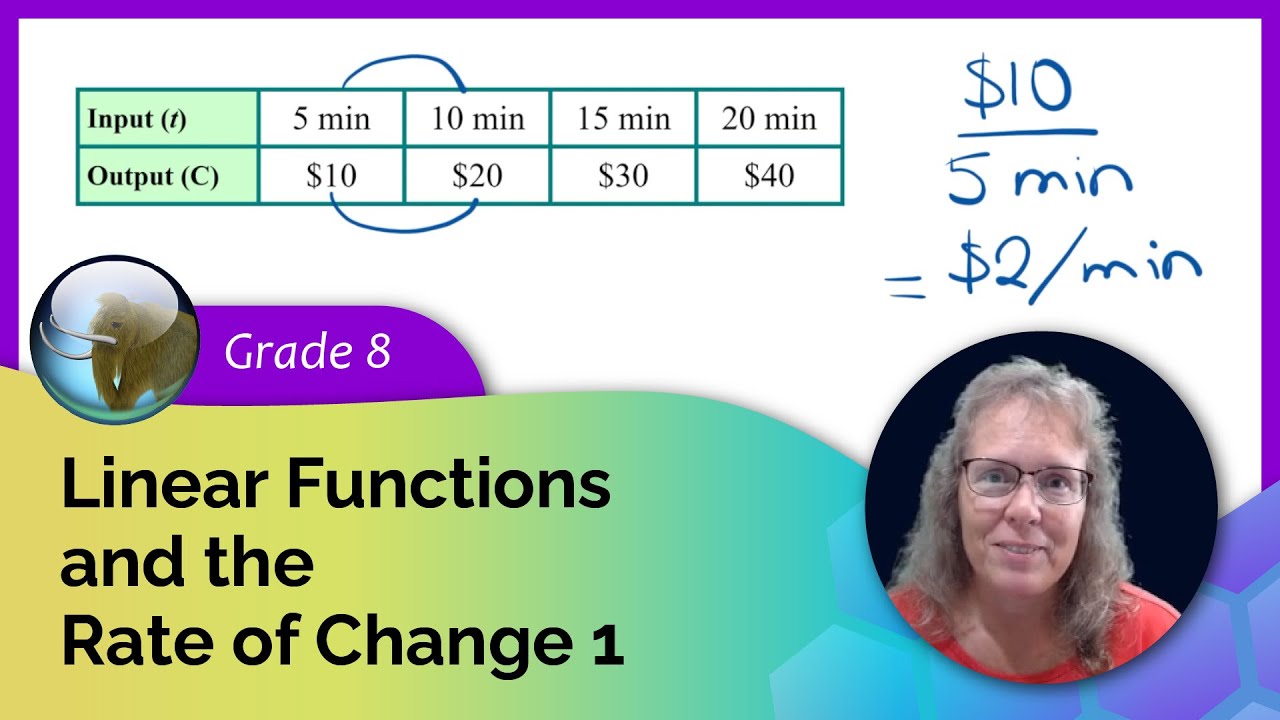
The rate of change of a function is this ratio: (change in the output values/change in the input values). We look at this concept through various examples, calculating the rate of change from tables of values and from the graph of a function. (Later on, you will learn this is the same as slope, in the context of graphing.) Math Mammoth Grade 8 Curriculum
قد يعجبك أيضًا
March 2024 KIDS Songs from LooLoo Kids
CoComelon | Netflix Jr
Happy Holidays from Netflix Jr!
Popular Compilations by CoComelon
PrePrimary Maths
Year2 Maths
Year 10 Math
Year6 Maths
Year1 Maths
Year 11 Math
Year5 Maths
AR Videos
Year 2 Math
Maths
Numberblocks - Learn to Count | Maths for Kids
3rd Grade Math
Maths Grade 1
Linear Equations - Change of Subject Formula - 10 - Change of Subject of Formula 1
Системы уравнений и неравенств
SSC Math part 1 video - Maharashtra board video
Year7 Maths
Year 1 Math
JSS 2 Junior Mathematics
Grade 12 Euclidean Geometry
التعليقات
4 تعليق
In mathematics, a function is a relation between two sets where each element in the first set is mapped to exactly one element in the second set. The first set is the set of INPUTS and the second set is the set of OUTPUTS. So, each input is mapped to exactly one output. But what if some of the outputs are the same? Is that allowed? What if some element has no output? For example, in the example about rooms and their colors, what if some room has no color assigned to it? Is it a function? We also look at some numerical examples where a function is given as a list of ordered pairs. A function can also be given as a rule, such as x mapping to x squared. We look at the graph of that function in the coordinate plane (for certain integer values only). Math Mammoth Grade 8 Curriculum https;//
In mathematics, a function is a relation between two sets where each element in the first set is mapped to exactly one element in the second set. The first set is the set of INPUTS and the second set is the set of OUTPUTS. So, each input is mapped to exactly one output. But what if some of the outputs are the same? Is that allowed? What if some element has no output? For example, in the example about rooms and their colors, what if some room has no color assigned to it? Is it a function? We also look at some numerical examples where a function is given as a list of ordered pairs. A function can also be given as a rule, such as x mapping to x squared. We look at the graph of that function in the coordinate plane (for certain integer values only). Math Mammoth Grade 8 Curriculum https;//
The rate of change of a function is this ratio: (change in the output values/change in the input values). We look at this concept through various examples, calculating the rate of change from tables of values and from the graph of a function. (Later on, you will learn this is the same as slope, in the context of graphing.) Math Mammoth Grade 8 Curriculum
The rate of change of a function is this ratio: (change in the output values/change in the input values). We look at this concept through various examples, calculating the rate of change from tables of values and from the graph of a function. (Later on, you will learn this is the same as slope, in the context of graphing.) Math Mammoth Grade 8 Curriculum