
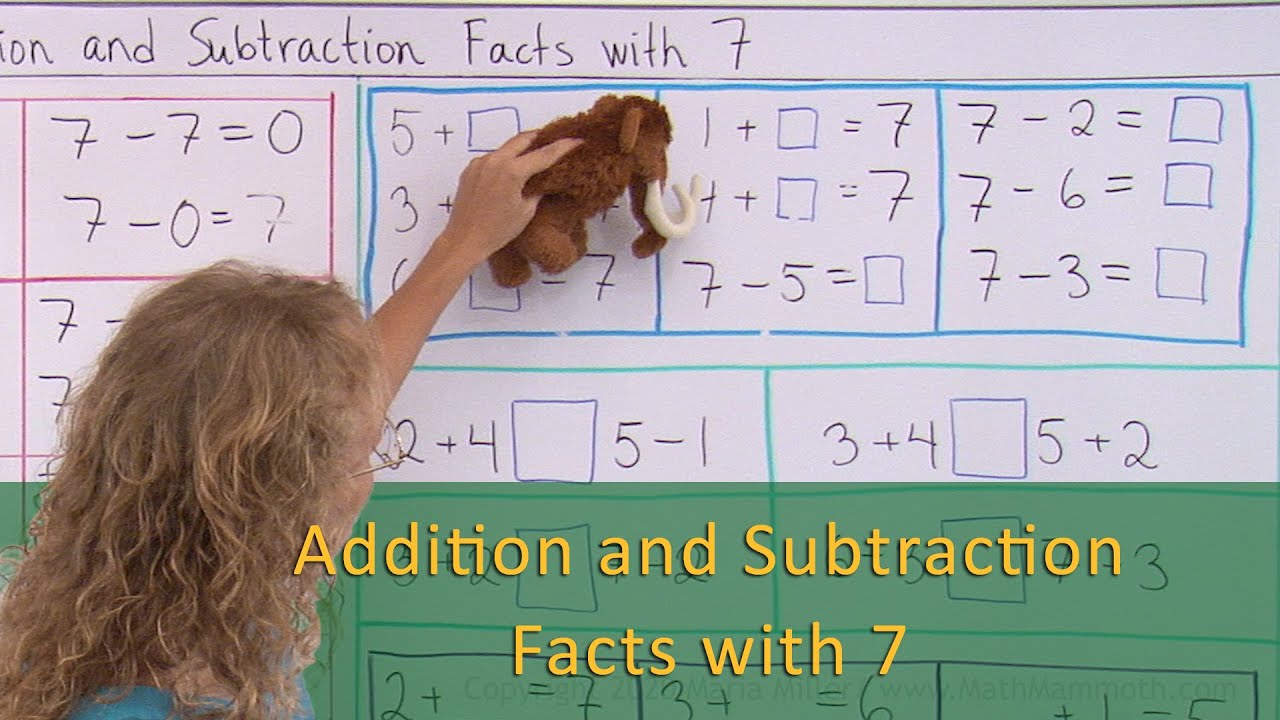
I show all the fact families with the sum of 7, organized into a table. Seeing the structure and the patterns in this manner helps develop number sense and helps children in the memorization work, also. Then we drill the facts for a bit. The lesson also includes an exercise where we compare expressions ("alligator mouths") and draw lines connecting facts from the same fact family.
قد يعجبك أيضًا
Year3 Maths
Year 8 Math
Numberblocks - Learn to Count | Maths for Kids
3rd Grade Math
PrePrimary Maths
Year1 Maths
Year 11 Math
Year2 Maths
Year 10 Math
Year4 Maths
How to Play Chess
3rd Grade Fractions
A savoir faire en mathématiques en Seconde
Fonctions exponentielles 2SPC/Terminale S/cours et exercices corrigés fonctions exponentielles/étude fonction exponentielle/examens nationaux /Astuces
Best Classifying, Sorting, and Matching Videos for Toddlers | Learning and Matching Colors for Kids
Number and Numeration 2 - Factors and Multiples - 10 - Factors and Multiples: Questions
Year5 Maths
Maths
Numberblocks - Homeschooling #Stayhome ✏️📘
Numberblocks - Season 2 | FULL EPISODES
Bengali Kids Cartoon Videos
Introduction to Software Engineering
ChuChu & Friends in Storytime Adventures - ChuChu TV
Introduction to Artificial Intelligence (AI)
التعليقات
8 تعليق
I show all the fact families with the sum of 9, organized into a table. Seeing the structure and the patterns in this manner helps develop number sense and helps children in the memorization work, also. Then we drill the facts for a bit. The lesson also includes a missing number exercise, an exercise where we compare simple addition and subtraction expressions, and word problems (with Mathy :^).
I show all the fact families with the sum of 9, organized into a table. Seeing the structure and the patterns in this manner helps develop number sense and helps children in the memorization work, also. Then we drill the facts for a bit. The lesson also includes a missing number exercise, an exercise where we compare simple addition and subtraction expressions, and word problems (with Mathy :^).
I show all the fact families with the sum of 6, organized into a table. Seeing the structure and the patterns in this manner helps develop number sense and helps children in the memorization work, also. Then we drill the facts for a bit. The lesson also includes an exercise where draw lines connecting facts from the same fact family, and a word problem.
I show all the fact families with the sum of 6, organized into a table. Seeing the structure and the patterns in this manner helps develop number sense and helps children in the memorization work, also. Then we drill the facts for a bit. The lesson also includes an exercise where draw lines connecting facts from the same fact family, and a word problem.
I show all the fact families with the sum of 8, organized into a table. Seeing the structure and the patterns in this manner helps develop number sense and helps children in the memorization work, also. Then we drill the facts for a bit. The lesson also includes an exercise of finding missing numbers (a little bit of algebra in disguise), and some word problems.
I show all the fact families with the sum of 8, organized into a table. Seeing the structure and the patterns in this manner helps develop number sense and helps children in the memorization work, also. Then we drill the facts for a bit. The lesson also includes an exercise of finding missing numbers (a little bit of algebra in disguise), and some word problems.
I show all the fact families with the sum of 7, organized into a table. Seeing the structure and the patterns in this manner helps develop number sense and helps children in the memorization work, also. Then we drill the facts for a bit. The lesson also includes an exercise where we compare expressions ("alligator mouths") and draw lines connecting facts from the same fact family.
I show all the fact families with the sum of 7, organized into a table. Seeing the structure and the patterns in this manner helps develop number sense and helps children in the memorization work, also. Then we drill the facts for a bit. The lesson also includes an exercise where we compare expressions ("alligator mouths") and draw lines connecting facts from the same fact family.